Here our final project, the film opening to "Existence"
Showing posts with label AS Coursework. Show all posts
Showing posts with label AS Coursework. Show all posts
Thursday, 1 May 2014

Tuesday, 22 April 2014
Media Revision Essay 1
Discuss the ways in
which media products are produced and distributed to audiences, within a media
area you have studied
The constant and rapid advances in various areas of the film
industry concerning digital technology has majorly changed the way in which
films are made and distributed. There is not only a difference in how films are
made today compared to 20 years ago but also a significant difference depending
on the budget and location of the films production. From its making to its mass
viewing, anything from the budget of a film to its pre-production campaign to
the way it’s distributed can determine its success and profit of the film. When
combined with the advancing digital technology previously mentioned, and a
massively increased demand for big screen films, it is simple to see why recent
films, especially those in the past 10 years, have been the highest budgeting,
and in turn profiting, films in history. This success has in turn led to opportunities
for the bigger production companies, such as 20th Century Fox and
Universal, to pump out big budget upon big budget film at a more frequent
speed.
Because of these constantly advancing digital technologies however,
the mise-en-scene and production values of lower budget, low cast films such as
‘Monsters’ are catching up with the major, Hollywood/British blockbusters of
recent years – for example ‘Skyfall’. Although the difference between low
budget British and high budget British-American films couldn’t be more
different concerning the ability to mass produce, distribute and market, a
relatively tiny budget of $500,000 bought Monsters equipment with the ability
to parallel Skyfall’s monster $200m budget. The recording of Monsters footage
on to digital video, on multiple SD cards compared to the traditional 35mm film
strips is an example of how costs were cut majorly while maintaining high
production quality. This technique is one which can be utilised by any aspiring
film maker ad as such makes film-producing easier for the everyday person. One
way in which the film industry has not changed however, is the importance of a
films reputation and legacy in acquiring funding. The production of Skyfall was
aided by hundreds of part time investments, combined with a large sum obtained
from Eon Films and an even larger sum from MGM. This, being a Bond film, could
never be matched by an independent, low scale film such as Monsters which from
start to finish employed a minute percentage of the amount of workers its
counterpart did, relying on funding from part time investors and the independent
film production company Vertigo Films. The independence of Monsters is
something which worked for it in many ways. The two producers, previously
editors, were able to cut the value of the films production substantially. From
putting the shots together to the high quality CGI effects which were required,
the lack of need for alternate employees allowed the film to maximise profit
and cut costs compared to the no-expense-spared Hollywood Blockbuster. Again,
the ease and cheapness of access to editing programs such as Final Cut, Sony Vegas
and Adobe After Effects allows for an increase in independent film makers to
create their own products.
The recent increase in the convergence and synergy of major
companies and business’, especially within the film industry, has greatly
increased the ability of big name films to be distributed and in turn build anticipation
around the product. With both of Skyfall’s distributors being subsidiaries of Sony,
it set up the perfect opportunity for not only a Blu-ray release but also a
Playstation game to be produced and distributed months before the film itself.
This allowed for a greater profit from the Bond franchise as a whole but also
raised anticipation as to the individual films release. Because of this, the
budget for a full scale DVD release as well as the making of the game and
electronic memorabilia would have come from Sony which greatly reduced the cost
of the overall production. This cannot be matched by smaller budget films, for
example Eran Creevy’s film ‘Shifty’. With the majority of budget acquirement and
distribution coming from the independent company Metrodome Distributors and The
National Lottery UK, there was much less chance for a high budget, high production
value film. Instead, the director focused on friends and family to create the
film – emphasised by the fully British cast and production team. This can
easily relate back to the chances for independent film makers producing their
own films, which is supported by mainly British companies such as the BFI and
BBC.
The difference between big budget and small budget must be
looked at once again, however, in regard to a films exhibition and marketing.
With small budget films such as the two previously mentioned, the lack of expenditure
means the film must market itself, with hype being built up from film festivals
and small scale showings, as well as TV releases on primetime BBC, Channel 4
and ITV. This however is also changing, even within the past few years. Shifty
especially was majorly interested in the use of “Viral Marketing” in which the
film utilises the massive, exponentially increasing online market for “Social
Realist” products and films in general. Other examples of this being used is in
Cloverfield and more recently, Pacific Rim where alternate reality advertising
is used to increase audience interest. There are down sides to the increase in
films being made, and ease of making a film, however, as to get a product out
there more inventive and creative techniques must be used. This is especially
important in low budget films because of the negative side of advances in
digital technology, piracy. Moving from 50 Million+ illegal downloads of films
and TV shows 10 years ago to 50 Million+ illegal downloads of Game of Thrones
alone last season, cinema and box office takings must be maximised. This is not
such a problem for massively high budget films, especially ones such as
Skyfall, as the name and genre of the film lends itself to a cinema release no
matter the state of piracy – effecting the percentage profit lost much less.
Saturation of cinema screens can easily occur with big name big budget films,
leading to greater viewing figures and more niche markets, such as “The Grey
Pound” who prefer daytime showings – especially of films familiar to them.
Overall, the ease of production and distribution in this day
and age, where compared to recent history films can be produced for a
relatively tiny budget, still using top of the line equipment and distributed
on a rapidly increasing online market has led to a rise in independent film makers
and the amount of films produced. Examples of this are Kickstart.com and other
similar sites, in which investors may place money in to a film project and
receive rewards in return. No matter the ease of production however, big money
backing increases publicity and anticipation around big name films as well as
having more assets to market their name with. The big names are being
challenged however. Convergence has allowed portable viewing of multimedia, as
well as Netflix and Amazon Instant Player becoming readily available on phones
and tablets alike. This has caused audience fragmentation, allowing Arthouse,
Indie productions to gain popularity while IMAX and Odeon stereotypical
blockbusters become to have a sense of the familiar around them.
Wednesday, 26 March 2014
Evaluation Question 7
Looking Back at your Preliminary Task, What do you Feel you Have Learnt in the Progression from it to the Full Product?
The preliminary task was designed to introduce us in to the use of Final Cut and Motion as programs which were relatively new to all of us, with only our previous project "The Package" utilizing them, and even then only Final Cut. The Final product we produced shows, in my opinion, a whole other level of what can be achieved through the programs we had at our dispense than anything previously produced. The introduction of other technologies such as Motion, artificial lighting and microtracks to sync audio are all paramount in achieving what we did in our final film opening compared to the very amateur and low value first tasks.
Becoming more familiar with these products has allowed my partner and I to produce a whole other level of production quality, which has lead to not only better looking results but also a product of higher quality and care. Implementing such things as visual and sound effects which come as default with Final Cut, as well as the multiple more advance perks such as the true effects program motion and other editing programs such as Sony Vegas 12 and Adobe After Effects, allowed us to create something quite different from what was originally produced, even since our first draft of the fished product "Existence". Taking a look at the preliminary task (Shown below) the main skill in making it look like it does is the syncing of the shot reverse shots and music in conjunction with what was occurring in the scene. The more complex and advanced transitions and change in location in our final product however meant that these techniques could only be used to a certain extent, with a majority of the shots in our final product being action shots in locations with external conditions that could be detrimental to the look of the final piece. An example of this was the weather in the tower between the two days we shot the scene - from a tranquil and warm night to one where it was raining, bitterly cold and windy to the extent no voice could be heard even through the directional microphone. This meant that the voices had to be recorded separately, which could have had a majorly negative effect in the look of the shot (Bad lip syncing etc.) In this way, I learnt to take account for other variables than the actors and equipment as when filming in a real life situation, these are more likely to effect the look of the final product. It also helped me to learn back up shots should be taken for every shot, as if one has some sort of problem it is less hassle than reassembling actors and retaining permission for use of location.
Another way in which I have improved the way in which I made the opening scene to my film than the preliminary task is understanding of the media industry in general. Constant research as to our target audience, what people find interesting in different genre's of films (And in turn what is overdone and considered boring), certification and finally representation of social classes in media has allowed us to create something on basically no budget but with an interesting feel of something which hasn't been done much before. The idea, previously unoriginal and considered overdone, was added to by bringing in elements of the psychological. As shown in our audience research published earlier (http://alleynsmedia-levart.blogspot.co.uk/2013/11/target-audience.html) there was a major love for suspenseful, ambiguous action films in the 16-24 group especially. Because of this we tried to cater the opening especially to this group, with them also preferring films such as "Se7en" and "Dark Knight Rises" than "No Country for Old Men" and "Dual" of those who had seen all films. Likening our product to these, we had to focus on atmosphere and major character development than simple, everyday shots and characters. We also saw that this type of film had a niche market in the prime of life males, at around 40-50. This means that we would not only be attracting one type of audience, increasing popularity and almost making it a family film, being something a father could take his son (or even daughter) to. The Male Female gender difference was not emphasised much as in our target audience many of the females interviewed preferred an exciting, fast paced action film than the more stereotypical rom-com. In terms of characters, close observations as to everyday teenage/young adult tendencies and behaviours allowed us to not only develop characters in a more realistic way but also avoid the problem of obvious and derogatory stereotypes which represent the younger generation in a negative light. Implementing this research in to our film opening was vital in differentiating it from something made by School Students to one made by aspiring media amateurs.
A final way in which me and my partner have majorly improved since our preliminary task was how we use various equipment and the variety of shots taken. Taking the preliminary task as an example, the only shots used were that of shot reverse shot (Not very well done) panning shot (Shaky) and match on action. These are very easy to do as all include a steady camera with no artificial lighting and no need for additional sound being recorded. In our final product however (Shown below) the type of shot vary from panning establishing shots, to moving action shots, to perspective shots and everything in between. The sheer variety of shots without additional effects or music is enough to entertain an audience who understand the story. There was also a distinct lack off effects and technical skill involved with the making of the preliminary task. The Titles were made from a motion template on a regular black background with no skill needed. In our final product however a use of the effects program motion allowed us not only to make more interactive titles, with better looking colours and font type but also our production companies Ident. Completely animated in motion, we took individual layers of a Photoshop .PSD file made by both of us and saved them as .PNG, then imported them in to a motion project and added movement. Not only did this give us a greater ability to make more complex titles with various fades and colour schemes but also would differentiate ours from other Media A level students who would use regular templates.
Overall, since the making of me and my partners preliminary task we have not only learnt technical skills as to the programs we used but organisational skills and general practices which can be applied to future projects. The importance of thorough research with reference to target audience, certification and other films in the same genre has allowed us to create something fitting the topes of the thriller while having another dimension of the psychological. A highly detailed level of preparation is also required to create a high quality of the final product, two things that we found had a strong correlation. Obviously, regarding the editing stage, increased levels of understanding of Final Cut, Motion and Adobe After Effects has allowed us to create a more professional looking project. Overall, the development of editing skills, research techniques and use of general technical equipment usage has allowed us to create something much better looking and advance than our original project.
JL
JL
Friday, 21 March 2014
Evaluation Question 6
What Have you Learnt About Technologies from the Process of Constructing this Product?
As can be seen above, a voice over of our film opening talking about what me and my partner have learnt from the extensive use of technology in the construction of our final product. Mentioned are Motion, Adobe After Effects, Final Cut and Various other things which were essential in making our film as it is at this point. A full write up can be seen in the essay on evaluation Question 7, which summarizes how we used various medial equipment in order to create different effects.
As can be seen above, a voice over of our film opening talking about what me and my partner have learnt from the extensive use of technology in the construction of our final product. Mentioned are Motion, Adobe After Effects, Final Cut and Various other things which were essential in making our film as it is at this point. A full write up can be seen in the essay on evaluation Question 7, which summarizes how we used various medial equipment in order to create different effects.
Friday, 14 March 2014
Evaluation Question 5
How Did You Attract/Address your Audience?


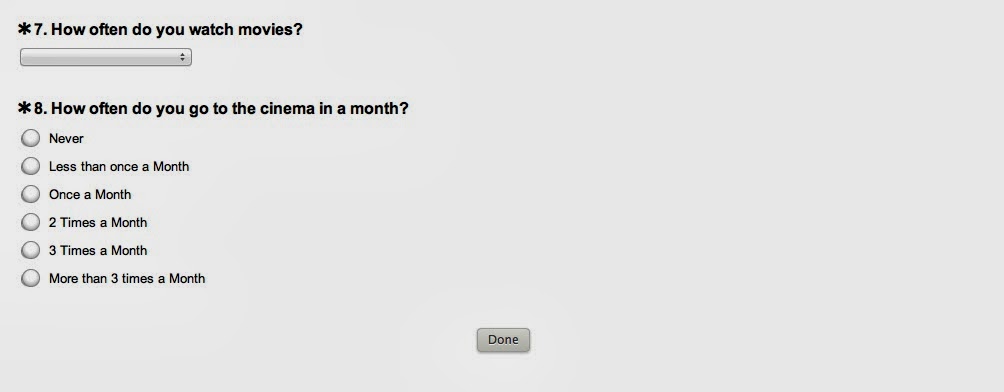

According to the survey that my partner and I made for market research, of 100 people that took the survey, only 35% of the people that took it were male. The majority of people that took the survey were between the ages of 30-50. Only 15% of the people that took the survey were between the ages of our target audience which we thought would be 15-24 before we had even collected the results from the survey. As we already had the genre of a psychological thriller in mind, the survey collected the results that the second highest genre of the people’s choice was the thriller genre. The highest was the genre of comedy. The survey showed me and my partner that the genre of Thriller would be a good idea as it was the second highest choice for the genre of film and also most of the people that took the survey were not even from our target market. If more of the people from our target market took the survey then the choice for the thriller genre probably would have been higher.
The target audience for the opening titles of the film, which we created, was 15-25. The scene is set in London in a small hotel room and then moves into a large building with a tall tower. The link between the opening titles and the audience is that all of the characters were between these ages as well. Although this was a student film and the characters were all 16/17 years of age, the characters were suppose to play roles of young adults. The link to the audience that my partner and I wanted to create was the characters age and situations they can relate to.
The modern aspects of the opening such as the smart phone that the main character has and the flat screen television in the lobby of the tower has a link to the target audience as modern technology and equipment. As we live in an age of technology and systematic devices, some of the target audience will almost likely have the same smartphone as the character if not one that is similar and/or having a flat screen television in their house or even in their own room.
These pictures show the modern technology in the smart phone and the flat screen television in the corner of the lobby.
With the weapon and the killing of the Tyrone in the opening, my partner and I wanted to make the murder as realistic as possible. This being shown as a knife is very easy to get hold of and everyone has a knife in his or her house. The unrealistic side of a killing in a film would be the normality and coincidence of the character having a gun. This I why we chose to use the idea of a knife as the murder weapon.
Crime in London is also a big topic. There are many news articles and stories about stabbings and killings in and around London all the time. As crime is normality in London, this can attract the audience, as it is something that they would be familiar with. This is not something that we wanted to spotlight in the film, which is why you cannot see the murder weapon during the killing. Also having a real knife in the location whilst filming could have been dangerous with the public still milling around the area and walking into shot.
This is the questionnaire that my partner and I sent out to determine our target audience and what kind of films and genres people liked. From these results we could understand what was the best way to display the opening to the target audience.
According to the survey that my partner and I made for market research, of 100 people that took the survey, only 35% of the people that took it were male. The majority of people that took the survey were between the ages of 30-50. Only 15% of the people that took the survey were between the ages of our target audience which we thought would be 15-24 before we had even collected the results from the survey. As we already had the genre of a psychological thriller in mind, the survey collected the results that the second highest genre of the people’s choice was the thriller genre. The highest was the genre of comedy. The survey showed me and my partner that the genre of Thriller would be a good idea as it was the second highest choice for the genre of film and also most of the people that took the survey were not even from our target market. If more of the people from our target market took the survey then the choice for the thriller genre probably would have been higher.
Some of the comments and responses of people and what they liked most about their favourite genre, which was thriller, was that the thriller genre “creates a fantastic thrill which keeps me intrigued” and “a good murder, not knowing who the killer is and the thriller murder”. This showed us that people liked a good thrill from the genre and that a murder is what would make the film more exciting.
When asked what was the three highest factors that would make them go and see a new film the top three choices from the survey were; storyline, friends recommendation and actors. My partner and I knew that to grasp the attention of our audience we would need to create a thrilling storyline that people would want to carry on and watch and stay through till the end of the film.
Sunday, 9 March 2014
Evaluation Question 4
Who Would be the Audience for Your Media Product?
Initially we did not know what the audience was going to be for our media product. The typical thriller genre would usually collect a broader range of people who would be interested in viewing the product at mainstream cinemas, however with the low budget we had and the distinct lack of high quality actors it would be difficult to generalise our films to other of a similar nature. The inclusion of an element of the psychological is also vital in differentiating our films from others of a similar genre, adding a feeling of the intellectual. Although this would narrow our range as a for targeting an audience, we saw this as a positive as we could cater to make the film appeal to the audience as much as possible. We did this by including action and character development, while maintaining a sense of mystery and ambiguity which was considered "Paramount" by the sample audience of our screening. Vox Pop's of reactions to the film can be seen below from various people who were in the audience of the screening, showing what they liked and disliked about the film, as well as what they would have wished to be done better. This sort of feedback is useful as in future projects we can not only see what to do better but what to subtly change in order to cater to a wider audience.
The idea of a 16-24 year old target audience came from the results of surveys we did which will be shown below:
-------------------------------------------------------------------------
The paper Based Survey was as follows:
1) Please State your age group
4) If there are significant sub genres of this film, please state which one is preferred (space under)
5) State a reason why you prefer this genre/Sub-genre and if there are any specific characteristics of the film genre which appeal to you
6) Please Rate the following films from 1-5, 1 being not seen the film hated and 5 being outstanding -
Se7en
Dual
Skyfall
No Country For Old Men
Dark Knight Rises
7) Where do you prefer to watch films? Please circle 1
-------------------------------------------------------------------------
This research was majorly infulential in our understanding of what sort of films were enjoyed by different age groups, as well as which tropes we should include and which we should leave out - this was to avoid stereotyping our film in to a specific genre while still making it accessible and typical of a psychological thriller. A follow up questionnaire was held post screening as well, asking similar questions but with a slight bias towards the thriller genre. The questionnaire and results were as follows:
-------------------------------------------------------------------------
1) Please State your age group
4) Of the product you have seen, please state what you enjoyed and thought could have been done better. If there were things you think could have been done better - please expand on this
5) Finally, what do you predict to come in the rest of the film?
-------------------------------------------------------------------------
This was filled out on a whole 14 times. Of the people who took part in the screening, 10 were of the age category 16-24 with 3 from 41-60 and 1 from 0-15. This range in audience participation was vital in seeing what could be improved as well as what was enjoyed. A mainly male audience however does not show the effect gender has on the opinions of the film opening which is something which we would definitely change in a future screening. We also found that of the 41-60 year old group, who were all male, 2 out of the three were massive psychological thriller fans. We believed that growing up with films like Se7en, Dual, Fight Club and many others which are influential in the genre it has created a niche market for fans of that age. Because of this, we believe that in future productions we should cater more to this audience as not only would it increase attendance but also possibly allow for our film to go in to the larger cinema's. One of these fans was shown previously in my audience research.
Summarised, The elder age group preferred very specific parts of the psychological thriller genre, not wanting too many stereotypical parts of it but maintaining the best sections. Chase scenes were seen as boring, whether in cars or person, as they had been overused previously and did not uphold much originality.
A final group in which we believe our media product could cater to is that of Media students taking various degrees. As a similar project to one undertaken globally, it can be looked to as an example of the use of more advanced technologies and equipment in order to create a film opening which both looks good and uses steady transitions and sound bridges to maintain a story line, moving from past to present and back again. This narrative structure is one commonly practiced in the genre, and as seen in both the vox pop's and the focus interview above, is one of the stronger points in the genre.
Finally, we found that the certification of the product was going to have a major effect on the audience we were going to attract. Previously in the term, a lot of time was spent researching the guidelines of the BFI Certification Ratings and the categories which were associated with each of these. Deciding on a 15 was a good choice in our opinion, due to what it is allowed and disallowed in this specific category. Quoting from the BBFC website, "No theme is prohibited, providing the treatment is appropriate for 15 year olds". This means that we could undergo our exploration of the psychological and pursue the causes of it without having to feel like we would hold back, as a 12 or 12a rating would have us do. Similarly, if we were to have an 18, it would rule out the lower two years of our target audience and also dissuade fathers from our niche audience to take son's as it suggests a more graphic, violent and disturbing tone in which nothing is prohibited. The lack of a moral compass found in 18's compared to the need for a moral compass in 15's was very influential in our decision, as it was the only thing that really determined the two certifications as separate. My partner and I decided that for the sake of a few changes in narrative (providing the final product was made) we could introduce people over 3 years younger to the film legally than a lack of a moral compass would have us do.
Audience and exhibition of film
The institution that would most likely want to exhibit our film would most probably be the Art House cinema companies. Although the Art House cinema chain is actually quite popular and large, our film would require small screening places in comparison to the City Centre cinema style of Multi-Screen Cinema. This is because our film is aimed at a younger generation who are more interested in studying film at University and at A Level than always going to see mainstream action thrillers in mainstream cinemas. The addition of the psychological element to an already overused plot was something which we wished would set our film aside, and as such move away from more typical blockbusters and independent thrillers.

The age of our target audience is 15-24 and so these would also be the ages studying film at higher levels. This makes our audience much smaller and so probably would not attract enough people for a place in a huge cinema. The niche market of mid 40's however allows scope for a broadening in marketing, and if was proven to be popular in Art house could be transposed to main cinema's as a father son or even father and mates film.

Because our film obviously is, and looks, low budget (especially as it is shot in London without big star Hollywood actors), our film may not attract the larger audience for mainstream films, such as Skyfall. This means that if distributed in a Multi-Screen or Multiplex cinema, the majority of people who went there to see mainstream/high budget films would not want to watch our film. Again, this could be questioned as success on a smaller stage would broaden our audience.

The low budget concept also means that if our film was distributed, it would be impossible to have enough money to advertise it on a big enough scale for it to be screened in main-stream cinemas. Because of our low budget, we also would not be able to carry on distributing our film over a number of weeks in Multiplex cinemas that tend to show the same film repeated over a series of weeks. By distributing it within a 'indie', arthouse cinema, people would come to see it, knowing that it would be of low budget.

Initially we did not know what the audience was going to be for our media product. The typical thriller genre would usually collect a broader range of people who would be interested in viewing the product at mainstream cinemas, however with the low budget we had and the distinct lack of high quality actors it would be difficult to generalise our films to other of a similar nature. The inclusion of an element of the psychological is also vital in differentiating our films from others of a similar genre, adding a feeling of the intellectual. Although this would narrow our range as a for targeting an audience, we saw this as a positive as we could cater to make the film appeal to the audience as much as possible. We did this by including action and character development, while maintaining a sense of mystery and ambiguity which was considered "Paramount" by the sample audience of our screening. Vox Pop's of reactions to the film can be seen below from various people who were in the audience of the screening, showing what they liked and disliked about the film, as well as what they would have wished to be done better. This sort of feedback is useful as in future projects we can not only see what to do better but what to subtly change in order to cater to a wider audience.
The idea of a 16-24 year old target audience came from the results of surveys we did which will be shown below:
-------------------------------------------------------------------------
The paper Based Survey was as follows:
1) Please State your age group
- 0-15
- 16-24
- 25-40
- 41-60
- 60+
- Male
- Female
4) If there are significant sub genres of this film, please state which one is preferred (space under)
5) State a reason why you prefer this genre/Sub-genre and if there are any specific characteristics of the film genre which appeal to you
6) Please Rate the following films from 1-5, 1 being not seen the film hated and 5 being outstanding -
Se7en
Dual
Skyfall
No Country For Old Men
Dark Knight Rises
7) Where do you prefer to watch films? Please circle 1
- Cinema
- Online (streaming or other)
- TV
- DVD/Blu-Ray
- Tablet
- More than 2 per week
- Once a week
- Once Every 2 weeks
- Once a month
- Less than once a month
- Arthouse
- Multiplex
- IMAX
-------------------------------------------------------------------------
This research was majorly infulential in our understanding of what sort of films were enjoyed by different age groups, as well as which tropes we should include and which we should leave out - this was to avoid stereotyping our film in to a specific genre while still making it accessible and typical of a psychological thriller. A follow up questionnaire was held post screening as well, asking similar questions but with a slight bias towards the thriller genre. The questionnaire and results were as follows:
-------------------------------------------------------------------------
1) Please State your age group
- 0-15
- 16-24
- 25-40
- 41-60
- 60+
- Male
- Female
4) Of the product you have seen, please state what you enjoyed and thought could have been done better. If there were things you think could have been done better - please expand on this
5) Finally, what do you predict to come in the rest of the film?
-------------------------------------------------------------------------
This was filled out on a whole 14 times. Of the people who took part in the screening, 10 were of the age category 16-24 with 3 from 41-60 and 1 from 0-15. This range in audience participation was vital in seeing what could be improved as well as what was enjoyed. A mainly male audience however does not show the effect gender has on the opinions of the film opening which is something which we would definitely change in a future screening. We also found that of the 41-60 year old group, who were all male, 2 out of the three were massive psychological thriller fans. We believed that growing up with films like Se7en, Dual, Fight Club and many others which are influential in the genre it has created a niche market for fans of that age. Because of this, we believe that in future productions we should cater more to this audience as not only would it increase attendance but also possibly allow for our film to go in to the larger cinema's. One of these fans was shown previously in my audience research.
Summarised, The elder age group preferred very specific parts of the psychological thriller genre, not wanting too many stereotypical parts of it but maintaining the best sections. Chase scenes were seen as boring, whether in cars or person, as they had been overused previously and did not uphold much originality.
A final group in which we believe our media product could cater to is that of Media students taking various degrees. As a similar project to one undertaken globally, it can be looked to as an example of the use of more advanced technologies and equipment in order to create a film opening which both looks good and uses steady transitions and sound bridges to maintain a story line, moving from past to present and back again. This narrative structure is one commonly practiced in the genre, and as seen in both the vox pop's and the focus interview above, is one of the stronger points in the genre.
Finally, we found that the certification of the product was going to have a major effect on the audience we were going to attract. Previously in the term, a lot of time was spent researching the guidelines of the BFI Certification Ratings and the categories which were associated with each of these. Deciding on a 15 was a good choice in our opinion, due to what it is allowed and disallowed in this specific category. Quoting from the BBFC website, "No theme is prohibited, providing the treatment is appropriate for 15 year olds". This means that we could undergo our exploration of the psychological and pursue the causes of it without having to feel like we would hold back, as a 12 or 12a rating would have us do. Similarly, if we were to have an 18, it would rule out the lower two years of our target audience and also dissuade fathers from our niche audience to take son's as it suggests a more graphic, violent and disturbing tone in which nothing is prohibited. The lack of a moral compass found in 18's compared to the need for a moral compass in 15's was very influential in our decision, as it was the only thing that really determined the two certifications as separate. My partner and I decided that for the sake of a few changes in narrative (providing the final product was made) we could introduce people over 3 years younger to the film legally than a lack of a moral compass would have us do.
Audience and exhibition of film
The institution that would most likely want to exhibit our film would most probably be the Art House cinema companies. Although the Art House cinema chain is actually quite popular and large, our film would require small screening places in comparison to the City Centre cinema style of Multi-Screen Cinema. This is because our film is aimed at a younger generation who are more interested in studying film at University and at A Level than always going to see mainstream action thrillers in mainstream cinemas. The addition of the psychological element to an already overused plot was something which we wished would set our film aside, and as such move away from more typical blockbusters and independent thrillers.
The age of our target audience is 15-24 and so these would also be the ages studying film at higher levels. This makes our audience much smaller and so probably would not attract enough people for a place in a huge cinema. The niche market of mid 40's however allows scope for a broadening in marketing, and if was proven to be popular in Art house could be transposed to main cinema's as a father son or even father and mates film.
Because our film obviously is, and looks, low budget (especially as it is shot in London without big star Hollywood actors), our film may not attract the larger audience for mainstream films, such as Skyfall. This means that if distributed in a Multi-Screen or Multiplex cinema, the majority of people who went there to see mainstream/high budget films would not want to watch our film. Again, this could be questioned as success on a smaller stage would broaden our audience.
The low budget concept also means that if our film was distributed, it would be impossible to have enough money to advertise it on a big enough scale for it to be screened in main-stream cinemas. Because of our low budget, we also would not be able to carry on distributing our film over a number of weeks in Multiplex cinemas that tend to show the same film repeated over a series of weeks. By distributing it within a 'indie', arthouse cinema, people would come to see it, knowing that it would be of low budget.
Tuesday, 4 March 2014
Evaluation Question 3
What Kind of Media Institution Might Distribute Your Media Product and Why?
In order to decide which media institution will end up distributing our media product, we must first define distribution. A distribution company, as a distributor and marketer, is expected to raise awareness of the film through varying marketing campaigns as well as forming deals with other conglomerate's such as Sony in order to aid the DVD, TV and internet release. The above video describes the positives and negatives of 5 different distribution companies; from multinational to English and from part of a firm to independent.
In order to decide which media institution will end up distributing our media product, we must first define distribution. A distribution company, as a distributor and marketer, is expected to raise awareness of the film through varying marketing campaigns as well as forming deals with other conglomerate's such as Sony in order to aid the DVD, TV and internet release. The above video describes the positives and negatives of 5 different distribution companies; from multinational to English and from part of a firm to independent.
Friday, 28 February 2014
Evaluation Question 2
How Does Your Media Product Represent Particular Social Groups?
The below Prezi shows how in our final media product, we represented particular social groups and whether it is positive, negative or fairly represented. The variety of representation is shown through the various characters showing the same social status or contrasting with each other in order to form ideologies and explicit and implicit ideas.
We found that within a two minute opening only containing three characters worth mentioning it was hard to portray a fair representation of social groups, especially as meetings between people are either lacking words or containing people from different social medians.
The below Prezi shows how in our final media product, we represented particular social groups and whether it is positive, negative or fairly represented. The variety of representation is shown through the various characters showing the same social status or contrasting with each other in order to form ideologies and explicit and implicit ideas.
We found that within a two minute opening only containing three characters worth mentioning it was hard to portray a fair representation of social groups, especially as meetings between people are either lacking words or containing people from different social medians.
Saturday, 22 February 2014
Evaluation Question 1
In What Ways Does Your Media Product Use, Develop or Challenge Forms and Conventions of Real Media Products?
In this prezi you will find out how different films influenced ideas in the opening 2 minutes for our film and what makes a psychological thriller and what factors make up a psychological thriller. The prezi also shows the influence for the genre of film and why we used the idea of a psychological thriller.

Above is the title of our film. This is shown at the end of the opening 2 minutes so that it introduces the rest of the film and shows that the opening 2 minutes is only just the beginning. The reason that we wanted to use the title of existence is because with the psychological thriller genre my partner and I wanted to create a mysterious title with a sense of the supernatural and the unknown. We also felt that the title sounded cool so that is probably the main reason why we used it.
The font that we used for the title of our film was called True Lies. This was a font that we found on the internet and then downloaded onto the computer to use for the title of the film. We used this font because it stood out against other typical fonts used for text and also we liked the cool and modern look to the title which is used as well for showing the modern aspects to the film.


The two pictures above show the costumes for the Killer (Kevin) and the victim (Tyrone). The costumes were used just to show two socially normal people wearing everyday clothes and not being out of the ordinary. The clothes are modern; things anybody would wear. This is something that me and my partner wanted to highlight and having two normal looking people be mixed up in a very unnatural situation surrounded by an abnormal situation and society. The crime was set up so that it looked like anyone could have done it. The influence of everyday London was idea that my partner and and I wanted to display in our opening to our film, the normality and unsuspicious ways of the two main characters who were displayed in the open and mixed with everyday civilians. The use of the knife as an everyday
In this prezi you will find out how different films influenced ideas in the opening 2 minutes for our film and what makes a psychological thriller and what factors make up a psychological thriller. The prezi also shows the influence for the genre of film and why we used the idea of a psychological thriller.
Above is the title of our film. This is shown at the end of the opening 2 minutes so that it introduces the rest of the film and shows that the opening 2 minutes is only just the beginning. The reason that we wanted to use the title of existence is because with the psychological thriller genre my partner and I wanted to create a mysterious title with a sense of the supernatural and the unknown. We also felt that the title sounded cool so that is probably the main reason why we used it.
The font that we used for the title of our film was called True Lies. This was a font that we found on the internet and then downloaded onto the computer to use for the title of the film. We used this font because it stood out against other typical fonts used for text and also we liked the cool and modern look to the title which is used as well for showing the modern aspects to the film.
The two pictures above show the costumes for the Killer (Kevin) and the victim (Tyrone). The costumes were used just to show two socially normal people wearing everyday clothes and not being out of the ordinary. The clothes are modern; things anybody would wear. This is something that me and my partner wanted to highlight and having two normal looking people be mixed up in a very unnatural situation surrounded by an abnormal situation and society. The crime was set up so that it looked like anyone could have done it. The influence of everyday London was idea that my partner and and I wanted to display in our opening to our film, the normality and unsuspicious ways of the two main characters who were displayed in the open and mixed with everyday civilians. The use of the knife as an everyday
Friday, 21 February 2014
Editing - Final Cut Final Week
This week was just used to add final touches to an already nearly finished piece. Re arranging the motion projects that we used for titles, including changing the names of various roles so we weren't mentioned more than once, and the colour of the text to make it stand out more, and the continuity of the shots were paid special attention to while also employing minor changes. The ident was also added in and given sound. The final project will be up soon with the evaluation questions following it.
Thursday, 20 February 2014
Existence Final Rough Cut
Another draft of the final thing. Multiple minor changes include the introduction of the motion titles in what we believe will be their final place and the added sound to give the opening a greater effect of tension and depth.
Wednesday, 19 February 2014
Evaluation Questions
After finishing the production of our film opening, we were given seven evaluation questions which were designed to make us question our decisions and what we would do differently at a different time. Me and my partner split the questions between us, with me doing questions 2,4 and 6 while he did the odd numbers. Both of us did question 7 separately. During answering the questions we will have to analyse our decisions as to camera work, sound, editing, shot type, angle and narrative structure. We will also look at target audience, distribution of our opening and representation of social groups as a whole.
The Questions were:
The Questions were:
- In what ways does your media product use, develop or challenge forms and conventions of real media products?
- How does your media product represent particular social groups?
- What kind of media institution may distribute your media product and why?
- Who would be the audience for your media product?
- How did you attract/address your audience?
- What have you learnt about technologies from the process of constructing this product?
- Look back at your preliminary task, what do you feel you have learnt in the progression from it to the full product?
Thursday, 13 February 2014
Existence Rough Cut 1
This is the first idea of what the opening could look like. Changes need to be made as to the titles, which includes adding in the motion projects showed in the previous post, and a change in music when bridging the opening two shots. We are also debating as to whether we should add in other shots while cutting some down to not make the opening seem so drawn out.
Editing - Final Cut Week 2/Penultimate Week
This week of editing in Final Cut was spent syncing music, changing from a fade of two separate non copyright songs to fading in one of them earlier and looping the main part of it. This was to link the two scenes together, as we felt that if we didn't they would be too disjointed and first time viewers would have little idea of the two scenes being related. We also changed the order of shots in regards to the tower scene and what led up to it. Shortening the panning shot inside the building's lobby and introducing a shot inside the elevator, as well as moving the panning/establishing long shot of the building earlier in the sequence. This was all to add depth to a lengthy progression of action shots and to allow us to cut our film opening in insignificant places (end of shots etc.)
Another major change that we made was of the brightness of individual clips in order to reflect the atmosphere in the individual clip. In the scene where Barney, or Kevin, answers the phone we decided to lower the lighting while inside the room compared to the light outside which was representative of his inner conflict. We also lowered the lighting of the last 10 seconds of the opening which emphasised the shadows and created a more tense, dangerous atmosphere.
Another major change that we made was of the brightness of individual clips in order to reflect the atmosphere in the individual clip. In the scene where Barney, or Kevin, answers the phone we decided to lower the lighting while inside the room compared to the light outside which was representative of his inner conflict. We also lowered the lighting of the last 10 seconds of the opening which emphasised the shadows and created a more tense, dangerous atmosphere.
Saturday, 8 February 2014
Editing - Motion/Titles
We used motion in order to create the actor and director titles - this is because more can be done with text in Motion than Final Cut including fades and angling text. In order to create them we put the rough cut together then found establishing shots which weren't related to the story to place the titles over. Using our previous knowledge of openings that we found from our research, the main titles we included were the actors, directors, casting directors, and musician's used. These can all be seen below, having been individually rendered and uploaded to re-integrate in to the film.
The first we did were the casting directors as it was in the tower which is where the main focus of our first week of editing has been due to particular problems with sound a lighting.
The next is that of Kevin's boss, in the phone scene. Having not much of the characters face shown in a relatively long shot was a perfect opportunity for a title, so we chose the actor shown.
Obviously, the main actors needed a more obvious introducing so we set these titles during pan or still shots with only one main thing in shot. This would draw attention to the name and actor, and emphasise their importance in the opening.
Similar emphasis on identity can be seen in the title shot of David Bucknor
Final title sequence we finished was that of the music artist in the opening.
The first we did were the casting directors as it was in the tower which is where the main focus of our first week of editing has been due to particular problems with sound a lighting.
The next is that of Kevin's boss, in the phone scene. Having not much of the characters face shown in a relatively long shot was a perfect opportunity for a title, so we chose the actor shown.
Obviously, the main actors needed a more obvious introducing so we set these titles during pan or still shots with only one main thing in shot. This would draw attention to the name and actor, and emphasise their importance in the opening.
Similar emphasis on identity can be seen in the title shot of David Bucknor
Final title sequence we finished was that of the music artist in the opening.
Tuesday, 4 February 2014
Editing - Final Cut Week 1
TheFirst week of editing started off well, having already started placing clips together as footage came in week by week, with the final footage taken we could get the final order sorted out and choose the best of each shot we took (Having taken more than one of all). The lighting and sound of some clips had to be adjusted using final cut effects such as side lights and mainframe. We adjusted the sound of some of the tower scenes using the "Radio" effect in order to reduce background noise while maintaining speech clarity and volume. We also made a start on the titles for each actor, using motion for the fade on the text and the colour and angle it was to appear at. We think we will choose establishing shots to do this on as it does not take away from the story and means more focus can be placed upon the names associated with the film.
Wednesday, 29 January 2014
Editing - The Start
Having all clips collated and analysed, with the best sections of every shot taken as well as back ups for each section, it is time to start editing. Having already finished the ident previously, we can easily start on the film its self with the 2 minute limit in mind. We are obviously hoping that there are no problems with the shots and no more will need to be taken, however we are prepared for this if this is the case. Going in to Final Cut, from our experience of "The Package" and our Preliminary Task, we are much more confident as to how to use it and the specifics of the effects.
Friday, 24 January 2014
Pre Editing Decisions and Problems
Decisions:
- We thought that the mix of present day and flashbacks put so closely together, without much introduction, would be hard to differentiate between for first time viewers. To overcome this, we decided that all flashbacks would be tinted with some sort of effect to be decided at a later date. This would obviously show the difference between the two time zones/periods while still linking the shots together.
- In terms of our filming, another way we decided we could differentiate between flashback and present day is through the camera work. The shaky way we filmed the first section with a moving handheld camera and up and down movement not only helped us show difference in time, but also created a sense of danger with the character in shot, and allow the audeince to empathise with his feelings and the immediacy of the event.
- We wanted a mix of close ups and mid shots in order to help establish the scene while also building tension in what is meant to be a very atmospheric opening scene. We took extra shots, at all angles and distances of the major shots in order to account for this.
- Pre Filming, one of the major decisions we had to make was that of clothing for the characters. Making them look too smart would be out of place in such an environment, while too shabby would discount the idea of modernism and a younger generation. In the end, the mix of jackets, hoodies and jeans for the two main characters while Kevin's boss wearing a suit clearly established a difference in power while maintaining a good look.
Problems/Revised Plans
- One of the major problems, already outlined in previous posts, was that of the speech in the tower. Having bad conditions on the day of filming, we had to use a voice over which was difficult due to syncing reasons. Thankfully, the low light of the shot meant the syncing didn't have to be perfect and with some precision this can easily be overcome.
- As mentioned above, changing conditions in a indecisive London were detrimental to some of the shots we wished to take, when paying attention to continuity issues and other specifics.
- Finally, we thought that lighting was going to be a major problem as in the alleyway scene we had the have the battery light moving to follow the camera, however we found that the light wasn't needed at all as the street lights gave us exactly the right amount or shadow, and in the right position.
Friday, 17 January 2014
Filming - Final Touches
With all of the shots involving actors finished, all that was left for the final few days before editing was re shooting any perspective shots needed as well as finalising the voice over of the tower scene. During the re recording of the voiceover, the connection from the mic to the microtrack was faulty; meaning when played normally the voice could only be heard from the left hand speaker/headphone. We overcame this via changing the audio type from mono to split mono during the editing stage the day after.
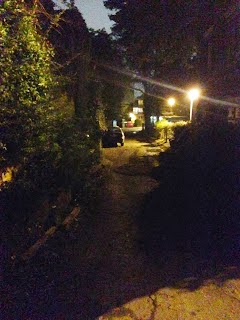
The above photo shows one of the scenes of the perspective shots, next to the alley. We found one of the perks of film making is not needing to have locations that are near each other, yet being able to make them look linked (The Alley scene and The tower scene). The continuity will come from editing and how we put the shots together.
Monday, 13 January 2014
Filming Day 2
Following last weeks filming we were feeling much more confident as to what we were doing. Getting more familiar with the positioning of lights, camera angles and the microtrack. With only 2 of the actors again, the only 2 that we needed to shoot the remainder of the clips, we went about re shooting the telephone scene due to bad light in the first take. Following this, we decided to take some extra shots which weren't planned in case the opening wasn't up to the correct length of 2 minutes. This location can be seen below, which was used in the final part of the flashback.

Again, we used both natural and artificial lights in order to create shadows and maintain the mood we wished to put across. The orange lighting of the Alleyway (Shown Below) was vital in establishing the aura of the flashback, and when put in to final cut and had effects added to it, made it look even better. At first glance, the effect we are going to use is labelled "Numerik" However this is open for debate as editing goes on.

Overall, we believe our filming to be finished now, especially as the perspective shots were done over the christmas holidays and if need be, can be re done without any of the actors.
There were problems however. When we went back to the top of the tower, the weather had changed for the worse - raining and very windy. This means that even with a directional microphone, the background noise was too great to hear the actors talk. We eventually decided on mouthing it, and doing a voice over the next day. On to editing, and the voice over.
Subscribe to:
Posts (Atom)